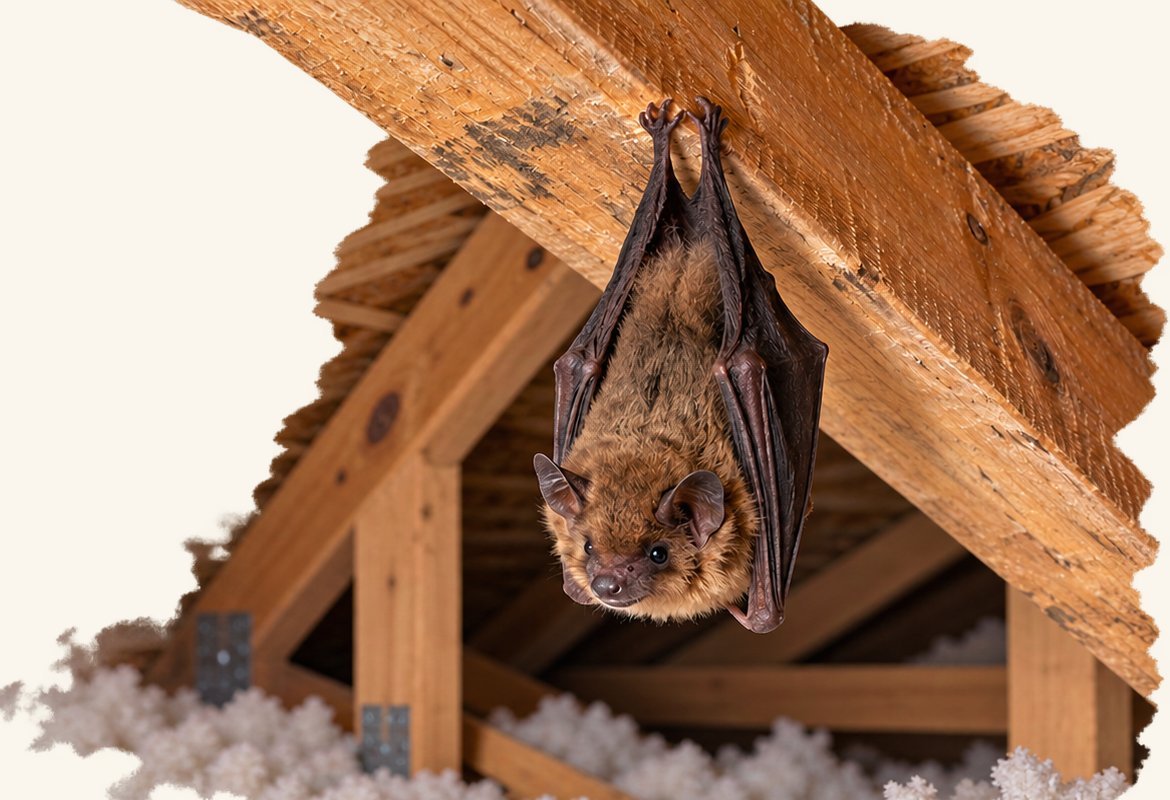
Bats in the attic How do bats get into an attic, and how do they get out?
Bats are useful. They eat insects. An attic colony is still a health and building problem, and the fix is timing plus a sealed gap, not poison.
By the Precision Guard Wildlife team · Updated
Key facts
Bats can enter an opening about 3/8 inch wide, roughly the width of a thumb.
They return to a roost that worked, and other bats may follow.
One-way valves let bats leave to feed and block the way back in.
Indiana DNR advises against colony removal from about June 1 through August 15, while pups are growing.
Heavy guano can grow Histoplasma, the fungus behind histoplasmosis. Do not sweep or vacuum a dry pile.
Any bite or scratch from a bat should be treated as a possible rabies exposure and seen by a doctor the same day.
Why an attic looks like a roost
An attic is warm, dark, quiet, and hard for predators to reach. That is close to a natural roost. Once a bat finds a gap that works, it may come back the next year, and other bats may join it.
Common doors are unscreened vents, cracks under worn eaves, a chimney that has pulled away from the flashing, a loose fascia or soffit, and gaps around pipes or wiring. The opening does not have to look like a hole from the sidewalk.
How does humane exclusion work?
Bats are protected in many states. Poison and a sticky trap are not a plan, and they are often illegal. The usual method is a one-way exit, sometimes called a bat valve, over each active opening. Bats leave at dusk to feed. The valve stops them from coming back. After the roost is empty, the gaps are closed with hardware cloth, caulk, flashing, or another material they cannot push aside.
Every opening they use has to be found first. Leave one gap open and the colony simply moves to it.
Why does the calendar matter?
Females gather in summer to raise pups. The young cannot fly for several weeks. Seal the exits during that time and the pups are trapped. That kills them, and the smell ends up in the walls. An inspection can happen in summer. The closing waits until the young can leave on their own.
Indiana is also home to bats that are endangered, including the Indiana bat. A roost is not something to guess about.
What are the health risks?
Histoplasmosis is a lung illness from breathing spores of Histoplasma capsulatum, a fungus that can grow in piled bat guano. Disturbing a dry pile, sweeping it, or vacuuming it can put spores in the air. People with weaker immune systems are at higher risk. A few crumbs are a clue. A heavy buildup is a cleanup job, not a Saturday project.
Bats can carry rabies. Transmission to people is uncommon, and a bite or scratch is still a medical issue the same day. Fleas, mites, and ticks from a colony can also move toward living spaces. Guano and urine stain insulation and, over time, wood and metal.
What changes by region?
Northeast Indiana
Indiana DNR says removal of a bat colony is not advised from about June 1 through August 15, while pups are growing. In northern Indiana, including the Fort Wayne area, a cold spring can push that window a little later. We inspect in summer. We do not seal flightless bats inside. The longer state page is the Indiana DNR guide to bats in buildings.
Central Ohio (coming soon)
Ohio also protects bats. Sealing a roost while pups cannot fly can kill the young and can conflict with state wildlife rules. The exact dates should be confirmed for the house before any Central Ohio attic is closed.
Common questions
Can bats be taken out in July?
They can be inspected, and the repairs can be lined up. Closing the exits waits until the pups can fly. In Indiana that is about August 15, sometimes later up north. Sealing them in kills the young and leaves a smell in the walls.
How small a gap can a bat use?
About 3/8 inch, close to the width of a thumb. Soffits, fascia, chimneys, ridge vents, and loose siding are the usual spots. They do not need a hole you could put a fist through.
Are the droppings dangerous?
A heavy pile of guano can grow a fungus people should not breathe as dry dust. Do not sweep or vacuum it. A few crumbs are a clue, not a crisis. The amount is something to see before anyone talks about a full attic clean.
What if one bat is in a room?
Close the door to the rest of the house, open a window or outside door in that room, turn off the ceiling fan, and give it time. If it keeps happening, the house has a door they already know.