
Is the snake in the attic venomous?
In the Fort Wayne area it is usually a gray ratsnake, and they are not venomous. Leave the identification to someone who does not have to hold it. A photo from across the room is enough.
They are not curious about your kitchen. They are following a meal, or they found a quiet place with a temperature they can use.
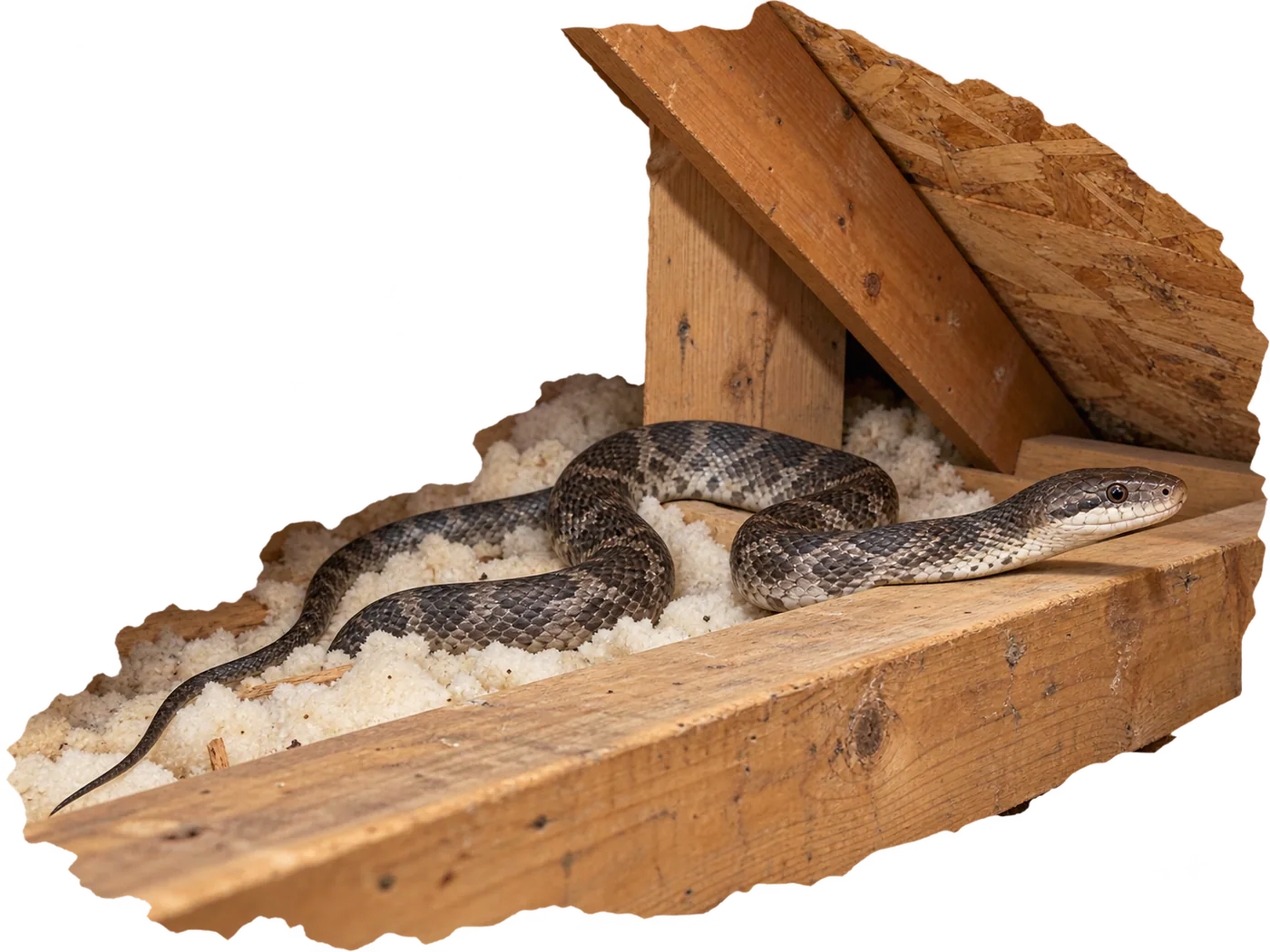
Often, yes. Many of the snakes that show up around houses, including rat snakes and garter snakes, eat small mammals. If mice are thriving in a garage, a crawl space, or along a foundation, a snake can follow that scent trail through a crack that a person would walk past.
They are not investigating the family. They are responding to food, a hiding place, and sometimes the weather. Take away the mice and a lot of the visits stop.
A snake flicks its tongue and reads those particles with the Jacobson's organ in the roof of the mouth. That is accurate enough to follow a rodent into a wall void or a crawl space. Once inside, they sit where it is quiet: basements, attics, garages, and the gaps between studs. Those are the same places mice already like.
Snakes are flexible. If the head fits, the rest often follows. Gaps under doors, cracks in a foundation, unsealed pipes, open vents, and pet doors are the usual list. In this part of the country, gray ratsnakes also climb, so an attic is not out of reach if mice are up there.
A photo from a safe distance helps. Picking a snake up to check the pattern is how a sure answer becomes a bite.
Control the rodents. Store food, close trash, and seal the holes mice use. Then close the snake-sized gaps: door sweeps, foundation cracks, vent covers, and utility penetrations. Reduce clutter along the foundation so there is less cover.
A snake in a room you need today gets a closed door and no audience. It does not get a broom.
Around Fort Wayne, a snake in an attic is usually an Indiana gray ratsnake. They are nonvenomous climbers, and they go where the mice are. Garter snakes and brown snakes are the other ones people meet near houses. Venomous snakes are uncommon in this part of the state, and they are not the ones pacing the rafters. Still, do not pick one up to check.
Snakes in Central Ohio houses are also usually following rodents or shelter. Which species are venomous depends on the county. Identification is not a hands-on job.
In the Fort Wayne area it is usually a gray ratsnake, and they are not venomous. Leave the identification to someone who does not have to hold it. A photo from across the room is enough.
It might. The snake, the opening, and the food are three parts of one problem. Removing only the snake leaves the reason it stayed.
Snakes do not make their own body heat. A building can be warmer than the ground in winter and cooler than the sun in summer. Shelter plus mice is a strong combination.
Not until you know where the snake is. Trapping it inside a wall is worse than a gap you can close in daylight after it has left.